The Mystery Woman of the Bennett Family
Patricia Beech is one of the most elusive figures connected to the great American singer Tony Bennett. While millions of fans know his music and his later marriage to Susan Crow, few people know much about the woman who was his first wife and the mother of his two sons. Born Patricia Ann Beech around 1933 in Cleveland, Ohio, she grew up in a traditional household that valued education and the arts . She studied art at Ohio University and also worked as a model, a profession that suited her natural elegance and quiet poise. Nothing in her background suggested that she would one day become the wife of one of the most beloved vocalists of the twentieth century.
Patricia met Tony Bennett in July 1951 at a nightclub called Moe’s Main Street in Cleveland, Ohio . Bennett was performing that evening, and Patricia was sitting ringside with another man. Despite her being on a date with someone else, Bennett noticed her immediately and was captivated by her beauty. After his set, Patricia’s date invited Bennett to join them at their table, and the conversation that followed changed the course of all their lives. Bennett learned that Patricia was not just a pretty face; she was an art student with a deep appreciation for jazz music, particularly the work of Symphony Sid, a famous disc jockey of the era. That shared love for music created an instant bond.
After her marriage to Bennett, Patricia Beech became a footnote in the singer’s biographies, often mentioned only briefly before the narrative moved on to his career or his later relationships. Yet she was far more than a footnote. She was a devoted mother who raised two sons who would become highly successful in the music industry. She was a wife who endured the pressures of fame and the loneliness of a touring musician’s schedule. And after her divorce, she was a woman of remarkable dignity who chose complete privacy over public attention. Patricia Beech may have stepped out of the spotlight, but her influence on the Bennett family legacy is profound and lasting.
A Whirlwind Courtship and a Ring at the Paramount
The romance between Patricia Beech and Tony Bennett developed quickly after that first meeting in Cleveland. Patricia moved to New York City to be closer to Bennett as his career was taking off, taking work as a brokerage assistant to support herself . Their courtship was intense and passionate, filled with late nights at jazz clubs and quiet mornings away from the chaos of show business. Bennett later wrote in his autobiography, The Good Life, about how drawn he was to Patricia’s intelligence, her taste in music, and her natural grace. He knew early on that he wanted to marry her, and he decided to make his intentions known in a dramatic fashion that was entirely in keeping with his rising star status.
During the Christmas holidays of 1951, Bennett was headlining at the Paramount Theatre in New York City, one of the most prestigious venues in the country. In front of a packed audience of thousands, he announced his engagement to Patricia Beech . The public proposal was a surprise to Patricia, who later said that she had not expected such a grand gesture. But she accepted, and the announcement made headlines across the country. For a young woman who had never sought fame, suddenly being thrust into the spotlight as the future wife of a national heartthrob was overwhelming. Yet Patricia handled the attention with the same quiet composure that would define her entire public life.
The engagement was relatively short, and the couple began planning a wedding that would take place in early 1952. Patricia was barely nineteen years old at the time, leaving behind her art studies and her quiet Ohio upbringing for the unpredictable world of celebrity marriage. She must have known that being married to Tony Bennett would not be easy. His career demanded constant travel, late nights, and the adoration of thousands of female fans. But she loved him, and she was willing to take on that challenge. The engagement ring he gave her was a symbol not just of their love but of her commitment to a life that would be anything but ordinary.
The 1952 Wedding That Shocked Thousands of Fans
On February 12, 1952, Patricia Beech and Tony Bennett were married at St. Patrick’s Cathedral in New York City, one of the most iconic religious landmarks in the United States . The ceremony itself was beautiful and traditional, but what happened outside the cathedral turned the wedding into a media sensation that neither Patricia nor Tony could have fully anticipated. Approximately two thousand female fans, many of whom were devastated by the news that their idol was marrying someone else, gathered outside the cathedral dressed in black clothing as a form of mock mourning . Some reports claim that these fans attempted to block Patricia from reaching the altar, so intense was their devotion to Bennett and so deep was their disappointment that he was no longer available.
Behind the scenes, there were rumors that the chaos had been orchestrated by Bennett’s manager at the time, Ray Muscarella, who was reportedly unhappy about his client’s decision to marry . Whether or not this was true, the scene outside St. Patrick’s captured the public imagination and cemented Patricia’s place in the gossip columns of the era. Photographs of the mourning fans appeared in newspapers across the country, and the story was discussed on radio shows and in magazine articles. For a young woman who had never sought fame, this level of attention must have been terrifying. Yet Patricia handled the situation with the same quiet composure that she would maintain throughout her marriage.
After the ceremony, the couple departed for a two‑week honeymoon in the Bahamas, hoping to escape the frenzy and begin their lives together in peace. The dramatic wedding became a defining moment in early Bennett lore, often referenced in biographies and articles about the singer’s life. For Patricia, however, it was merely the beginning of a long and complicated journey. She was now Mrs. Tony Bennett, a role that came with immense pressure and constant public scrutiny. The wedding may have been marked by theatrical protests, but Patricia’s commitment to her marriage was serious and sincere. She was ready to stand by Bennett’s side, even if thousands of heartbroken fans wished otherwise.
Building a Family in the Shadow of Stardom
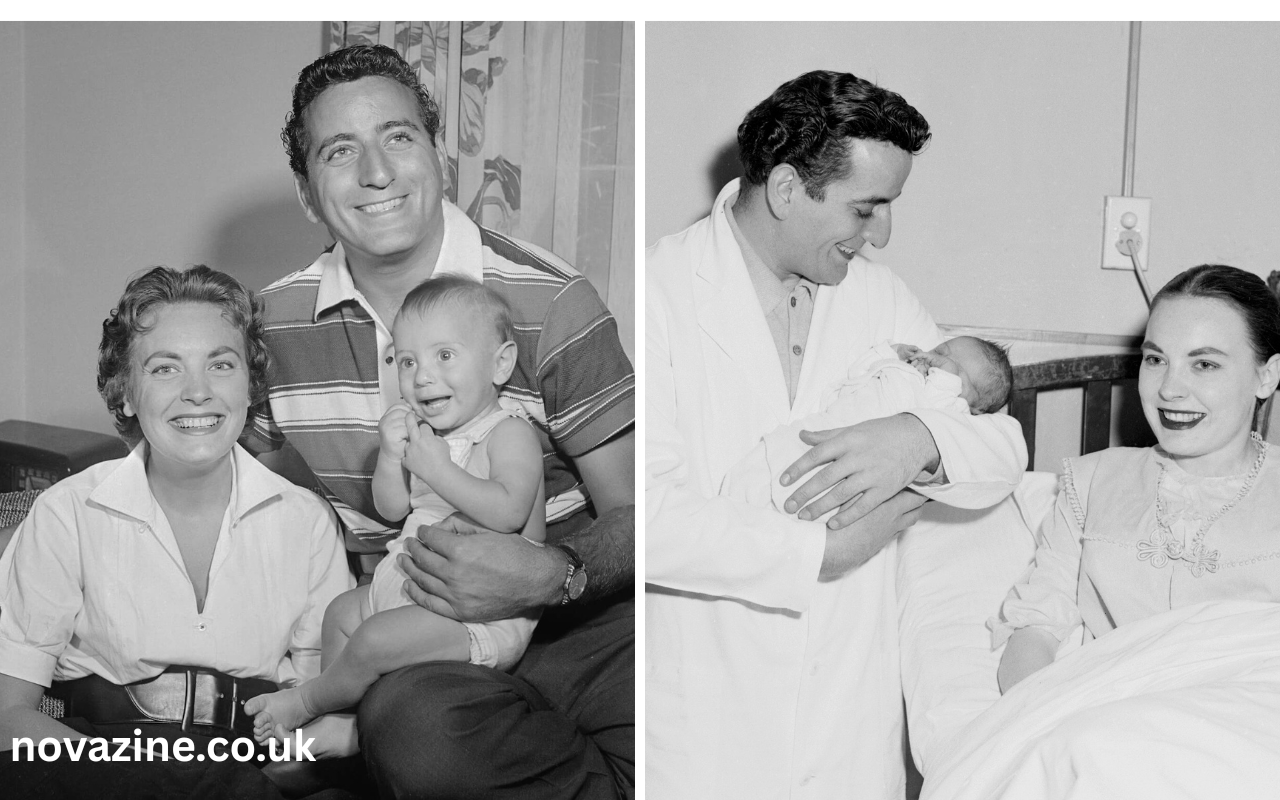
After their honeymoon, Patricia Beech settled into the role of a musician’s wife as Tony Bennett’s career exploded. The 1950s saw Bennett release hit after hit, including “Because of You,” “Blue Velvet,” and “Rags to Riches.” He performed constantly, often spending weeks or months away from home. Patricia initially accompanied him on some of his tours, enjoying the excitement and the opportunity to see the country . However, everything changed when the couple started a family. Their first son, D’Andrea “Danny” Bennett, was born on February 3, 1954 . Less than two years later, on October 15, 1955, their second son, Daegal “Dae” Bennett, was born .
With two young children to care for, Patricia stopped traveling with Bennett altogether. She accompanied him on his last tour in 1957, after which she focused entirely on raising Danny and Dae . The family purchased a house in the suburbs of Englewood, New Jersey, a quieter environment where the boys could grow up with more space and stability . Patricia devoted herself to creating a warm and loving home despite her husband’s frequent absences. She managed the household, took care of the boys’ education and health, and ensured that they had as normal an upbringing as possible. It was a demanding job, made more difficult by the fact that she was largely doing it alone.
While Tony was on the road, building his legend on stages across America and beyond, Patricia was the anchor of the family. She instilled in Danny and Dae the values of hard work, respect, and humility. She encouraged their interests and supported their ambitions. This period of her life, though largely undocumented by the media, was arguably the most important. The values she taught her sons would later manifest in their successful careers. Danny became a television producer and manager who played a pivotal role in revitalizing his father’s career in the 1980s and 1990s, introducing Tony Bennett to younger audiences through strategic television appearances. Dae became an accomplished audio engineer and the owner of Bennett Studios, where he worked on numerous important recordings. Patricia’s quiet dedication as a mother was the foundation upon which much of the Bennett family’s later success was built.
The Painful End of a Twenty‑Year Marriage
By the early 1960s, the strain of constant touring and prolonged separation began to take a serious toll on Patricia and Tony Bennett’s marriage. Bennett was spending more and more time away from home, and the distance created emotional rifts that were difficult to repair. In 1965, in an attempt to salvage their relationship, Bennett moved into a separate apartment . The hope was that some physical distance might reduce tension and allow them to reconnect. For a time, it seemed to work. Bennett moved back into the family home, and the couple appeared to be working through their difficulties. However, the underlying issues remained unresolved, and the marriage continued to deteriorate.
The definitive breaking point came when Patricia discovered that Bennett had become involved with another woman. While filming the movie The Oscar in 1965, Bennett met Sandra Grant, an actress who appeared in the film, and the two began an affair . The affair continued, and eventually, Bennett called Patricia from a hotel room where Grant answered the phone. That moment, Bennett later admitted in his autobiography, marked the official end of their marriage . Patricia filed for divorce, citing infidelity as the primary reason for the breakdown of their union. Interestingly, she had actually sued Bennett for divorce in 1959 on grounds of adultery, though they had reconciled at that time . The second attempt to save the marriage failed, and by 1969, Patricia had filed again, determined to end the relationship for good.
Their divorce was finally finalized in 1971, nearly twenty years after their dramatic wedding at St. Patrick’s Cathedral . The separation was painful, but Patricia handled it with the same dignity she had shown throughout their marriage. She remained in the family home in Englewood, New Jersey, raising their two sons, who were teenagers at the time, while Bennett moved on to marry Sandra Grant later that same year . While Tony’s career continued to soar, Patricia chose a different path. She stepped away from the public eye entirely, focusing on her children and her own private life. The pain of the divorce never became a public spectacle, thanks to Patricia’s decision to keep her feelings and her struggles out of the tabloids, a choice that demonstrated her remarkable strength of character.
Raising Two Sons Who Became Music Industry Powerhouses
After her divorce from Tony Bennett, Patricia Beech devoted even more of her energy to raising Danny and Dae Bennett. Unlike many children of celebrities who struggle with the pressures of fame, insecurity, or entitlement, both sons emerged as grounded, successful, and highly respected individuals. Danny Bennett, born in 1954, followed his father into the entertainment industry but chose to work behind the scenes. He became a television producer and, more importantly, his father’s manager. In the 1980s and 1990s, when Tony Bennett’s career had slowed down and younger audiences had largely forgotten him, Danny orchestrated a remarkable comeback. He introduced his father to younger audiences through strategic television appearances on MTV and collaborations with modern artists such as the Red Hot Chili Peppers and k.d. lang .
Dae Bennett, born in 1955, pursued a career in audio engineering and music production. He developed a reputation for technical excellence and a musical ear that made him highly sought after in the industry. Dae eventually opened his own recording facility, Bennett Studios, which became a destination for musicians seeking high‑quality production in a comfortable, creative environment . Throughout his career, Dae has worked on numerous projects, including recordings with his father and other major artists. Both sons have spoken respectfully about their mother over the years, acknowledging the stable and loving environment she provided during their childhood. Despite the challenges of having a father who was often on the road or living with another family, Patricia ensured that Danny and Dae never felt neglected, unloved, or less important.
The success of Danny and Dae Bennett is a direct testament to Patricia’s parenting. She raised them not as entitled children of a celebrity, accustomed to luxury and privilege, but as hardworking individuals who understood the value of dedication, craftsmanship, and humility. Danny’s managerial acumen helped Tony Bennett become a beloved figure across multiple generations, winning Grammy Awards well into his eighties and nineties. Dae’s engineering skills contributed to the high quality of Bennett’s later recordings, ensuring that the singer’s voice was captured with clarity and warmth. In many ways, Patricia Beech’s influence continued to shape the Bennett legacy long after her marriage ended. She may have stepped away from the spotlight, but her sons carried her values forward, ensuring that the Bennett name remained synonymous with excellence, integrity, and artistic passion.
A Life Chosen in Complete Privacy
Following her divorce from Tony Bennett, Patricia Beech made a conscious and deliberate choice to live entirely outside the public eye. Unlike many ex‑spouses of celebrities who write tell‑all books, sell their stories to tabloids, or grant interviews to share their side of the story, Patricia remained absolutely silent. She did not seek revenge against Bennett for leaving her. She did not attempt to capitalize on her connection to his fame. She did not air grievances about the affair that ended her marriage. Instead, she lived a quiet, dignified life, focusing on her family and her own well‑being . This decision has made her one of the most mysterious figures associated with the Bennett legacy, a woman about whom surprisingly little is known despite decades of public interest in her ex‑husband.
Because of this intense and steadfast privacy, there is significant confusion and conflicting information regarding Patricia’s current status, including whether she is still alive. Some online sources claim that she is still living, residing quietly somewhere in the United States, perhaps in New Jersey or Florida. Other sources suggest that she may have passed away without any public announcement or obituary . No credible death record has been made public, and the Bennett family has never released any official statement regarding her whereabouts or her condition. What is clear is that Patricia Beech valued her autonomy and her right to a life unexamined by the media. In an era when celebrity culture has become increasingly intrusive, with social media and twenty‑four hour news cycles invading every corner of private life, her ability to maintain that privacy for more than five decades is remarkable and admirable.
Patricia’s choice to live off the grid, so to speak, has added to her mystique. Fans of Tony Bennett often wonder what became of the young art student who captured the singer’s heart in a Cleveland nightclub. The absence of information has allowed speculation to flourish, but the most likely scenario is that Patricia simply wanted to be left alone. She had experienced the frenzy of fame, the chaos of a high‑profile wedding, the loneliness of a touring musician’s wife, and the pain of a very public divorce. Having raised her children and seen them become successful adults, she earned the right to a peaceful, private existence away from cameras, reporters, and curious strangers. Patricia Beech’s story is not one of tragedy or bitterness; it is a story of quiet strength and intentional obscurity, a reminder that not everyone wants to be famous.
The Confusion Surrounding Her Later Years
Read More : Courtney Crangi The CEO, Lacrosse Legend, and Fashion Industry Powerhouse
One of the most persistent mysteries surrounding Patricia Beech is the question of whether she is still alive and, if so, where she lives. Because she withdrew from public life so completely after her divorce, there are no reliable updates on her condition, her activities, or her whereabouts. Some online sources confidently state that she is still living, while others suggest she may have died without any public announcement . Adding to the confusion, there are unverified reports that Patricia Beech passed away in 2007, but these claims appear to be based on speculation rather than any documented evidence such as an obituary, a death certificate, or a public statement from the Bennett family . The family has consistently declined to comment on Patricia’s status, perhaps out of respect for her privacy.
Compounding the confusion is the existence of a different woman named Patricia Beck, a writer who lived from 1924 to 1978 and whose biography is sometimes mistakenly associated with Tony Bennett’s first wife . This Patricia Beck was a short story writer who studied at Bennington College and tragically died by suicide. However, this individual has absolutely no connection to Tony Bennett, his family, or his first wife. The similarity in names, with Beech and Beck differing by only two letters, has led to mix‑ups in online databases, genealogy websites, and even some poorly researched articles. It is essential to distinguish between these two women, as they lived completely different lives in different eras. Patricia Beech, Tony Bennett’s first wife, was an art student and model, not a writer, and there is no evidence linking her to Bennington College or to a suicide.
Given the lack of reliable information, the most responsible and honest approach is to acknowledge that Patricia Beech’s current status is unknown. She may be alive, living in quiet retirement somewhere in the United States, perhaps in her nineties, enjoying her grandchildren and great‑grandchildren. She may have passed away years ago without any public notice, exactly as she would have wanted because she never sought public attention. What matters more than her current status is the life she lived and the legacy she left behind. Patricia Beech was a devoted mother, a supportive wife during the early years of Bennett’s career, and a woman of remarkable discretion and dignity. In a world that often rewards self‑promotion, public confession, and the monetization of personal pain, her choice to remain silent and private is itself a powerful and increasingly rare statement.
The Enduring Legacy of Patricia Beech
Though Patricia Beech never sought fame, her impact on American music history is felt indirectly but profoundly through her children and her ex‑husband. By raising Danny and Dae Bennett to be hardworking, principled, and grounded men, she ensured that the Bennett legacy would continue with integrity and excellence. Danny’s management of Tony Bennett’s career, particularly his successful rebranding and reintroduction of his father to younger audiences in the 1990s, helped Bennett achieve a level of late‑career success that few artists in any genre have ever experienced. Without Danny’s strategic vision, Tony Bennett might have become a nostalgia act, playing oldies shows to aging fans. Instead, he became a Grammy winner in the new millennium, collaborating with Lady Gaga and Amy Winehouse. Dae’s work as an audio engineer preserved the quality of Bennett’s recordings, allowing future generations to appreciate the singer’s voice in pristine, beautiful condition.
Patricia’s story also serves as an important corrective to the way we often remember celebrity marriages and the women who stand beside famous men. In many accounts, the first wife of a famous singer or actor is reduced to a footnote, a cautionary tale, or a lesson about the perils of fame and the sacrifices women make for their husband’s careers. Patricia Beech deserves far more than that. She was a complete person with her own interests, her own talents, and her own dreams. She studied art at university, worked as a model, and later became a full‑time mother. These choices were not signs of weakness, lack of ambition, or dependency. They were signs of strength and clarity. She knew what she wanted, and she pursued it with quiet determination.
Ultimately, Patricia Beech’s legacy is one of dignity, resilience, and love. She loved Tony Bennett enough to marry him at nineteen despite the protests of thousands of screaming fans. She loved her children enough to dedicate her life to their upbringing, creating a stable and nurturing home despite her husband’s long absences. And she loved herself enough to leave a marriage that was no longer healthy, to step away from the public eye, and to protect her own peace and privacy for the rest of her life. In an age when every aspect of a celebrity’s life, and even the lives of those connected to celebrities, is dissected, shared, and monetized, Patricia Beech stands as a reminder that privacy is still possible and that some stories are meant to remain untold. Her life may not be fully documented in history books or biography websites, but her influence is felt every time Danny Bennett manages a show, every time Dae Bennett masters a recording, and every time a listener discovers the timeless voice of Tony Bennett. That is a legacy worth remembering and honoring.