The Accidental Rise of an Internet Legend
Leonardo DiCaprio Meme did not set out to become a meme lord. He spent decades perfecting his craft as a serious actor, taking on grueling roles that demanded emotional and physical transformation. From the sinking ship in Titanic to the frozen wilderness of The Revenant, his career was defined by intensity and dedication. Yet somewhere along the way, the internet decided that his face was the perfect canvas for expressing every human emotion imaginable. This transformation happened organically, without any marketing campaign or strategic planning, which is precisely why it feels so authentic and beloved.
The timing of DiCaprio’s meme ascendancy coincided perfectly with the golden age of reaction GIFs on platforms like Tumblr and Reddit. Around 2012 to 2014, social media users were hungry for visual shortcuts to express complex feelings quickly. DiCaprio’s highly animated acting style, filled with exaggerated smirks, wide-eyed stares, and manic laughter, provided an endless library of usable moments. Unlike actors who play stoic characters, DiCaprio wears his emotions on his sleeve, making every frame of his films a potential reaction image waiting to be discovered.
What makes his meme status unique is that he never tried to control or commercialize it. Many celebrities have attempted to manufacture viral moments or cash in on their online popularity, often with cringeworthy results. DiCaprio simply continued acting, and the internet continued extracting gold from his work. This hands-off approach has allowed his memes to evolve naturally, with fans assigning new meanings to old scenes. The result is a genuine cultural artifact that feels owned by the people rather than by a corporate branding team.
The Champagne Toast That Conquered Social Media
The single most recognizable Leonardo DiCaprio meme comes from Baz Luhrmann’s 2013 film The Great Gatsby. In this scene, Jay Gatsby stands amid falling confetti, surrounded by opulent party decorations, and raises a delicate champagne glass with a smirk that perfectly captures self-satisfied joy. The scene lasts only a few seconds in the movie, but those seconds have been looped billions of times across every social media platform imaginable. What makes this particular image so effective is the ambiguity of the expression. Is Gatsby being genuinely happy, sarcastically triumphant, or ironically superior?
When the trailer for The Great Gatsby dropped in December 2012, eagle-eyed fans immediately noticed the potential of this specific shot. Within weeks, Tumblr users began isolating the clip and pairing it with captions about finishing homework, getting a promotion, or simply surviving another Monday. The meme spread like wildfire because it tapped into a universal feeling. Everyone knows the sensation of wanting to celebrate a small victory without being too obvious about it. Raising a glass with a knowing smirk became the visual shorthand for quiet confidence and well-earned satisfaction.
The longevity of this particular meme is remarkable. More than a decade after the film’s release, the champagne toast remains a top choice for reaction images on Twitter and Reddit. It has been remixed, recolored, and recontextualized countless times, yet the core emotion remains instantly readable. In fact, when a French edition of The Great Gatsby was published in 2023, the translator explicitly credited DiCaprio’s meme for introducing the novel to a younger generation who might otherwise never have picked up the classic. A simple cinematic moment transformed into a gateway for literary appreciation.
The Manic Django Laugh for Chaotic Energy
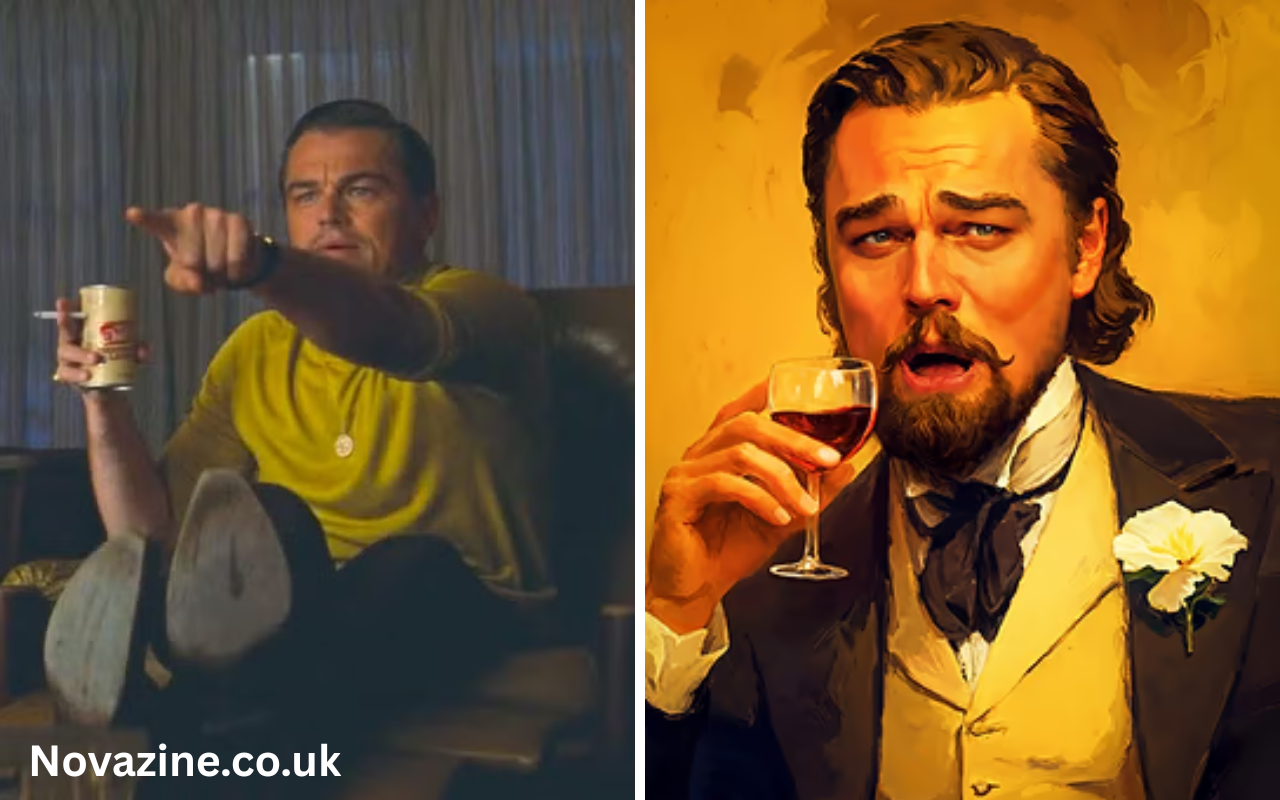
While the champagne toast represents controlled celebration, another DiCaprio meme captures pure chaotic energy. In Quentin Tarantino’s Django Unchained, DiCaprio plays the vicious slave owner Calvin Candie. During a tense dinner scene, his character erupts into a spontaneous, almost unhinged laugh while holding a crystal glass of red wine. The moment was actually unscripted. DiCaprio accidentally cut his hand during filming and kept acting, smearing real blood on his co-star’s face, and the resulting manic laughter was entirely genuine. This authenticity translates perfectly into meme form.
Internet users quickly adopted the Django laughing meme for situations that require expressing dark humor or enjoying someone else’s misfortune. When a friend makes an embarrassing mistake, when a rival fails at something obvious, or when you witness drama that does not involve you, this is the perfect reaction image. The laugh carries an undertone of superiority mixed with genuine amusement, which makes it suitable for teasing rather than genuine cruelty. Unlike the Gatsby toast which is about self-praise, the Django laugh is about observing the chaos around you with detached enjoyment.
This meme format gained renewed popularity during the 2024 and 2025 election cycles, where political commentators used it to react to various debate moments and campaign gaffes. Its versatility comes from the intensity of DiCaprio’s expression. He is not simply chuckling politely. He is laughing with his entire body, eyes wide, head tilted back, completely unguarded. This level of emotional rawness is rare in celebrity memes, which often rely on awkward or staged moments. The Django laugh feels dangerous and alive, which is why it remains a favorite for spicy online commentary.
The Once Upon a Time Pointing for Recognition
The third pillar of the Leonardo DiCaprio meme empire comes from Quentin Tarantino’s 2019 film Once Upon a Time in Hollywood. In this scene, DiCaprio’s character Rick Dalton sits on a couch, points excitedly at a television screen, and looks back at someone off camera as if to say, “I know that person.” The meme format exploded on Twitter and Reddit as the perfect reaction for moments of recognition. When you see an obscure reference that only true fans would understand, when you spot a friend in a crowd, or when a conversation suddenly aligns with your specific niche interest, the pointing Leo is your go-to response.
What makes this meme different from the previous two is its wholesome energy. The Gatsby smirk can feel arrogant, and the Django laugh can feel menacing, but the pointing Leo is pure excitement and connection. It suggests that you have found a kindred spirit or that your obscure knowledge has finally paid off. The expression on DiCaprio’s face is one of genuine surprise mixed with joy, as if he cannot believe his luck. This emotional tone has made the meme especially popular in fan communities, gaming forums, and academic Twitter, where people bond over shared interests.
The pointing meme also benefits from being easily editable. Users can add text above DiCaprio’s head describing the thing being recognized, and text next to his pointing finger explaining the context. This two-part structure allows for complex jokes that would not work with simpler reaction images. For example, someone might caption it with “Me explaining the plot of a movie nobody else has seen” pointing at “My friend who finally agreed to listen.” The format is so effective that it has spawned countless imitations using other actors, but the original DiCaprio version remains the gold standard.
The 2026 Oscars Live Meme Creation Event
In March 2026, something unprecedented happened in the history of celebrity memes. During the 98th Academy Awards ceremony, host Conan O’Brien decided to involve Leonardo DiCaprio directly in the meme-making process. O’Brien acknowledged DiCaprio as the undisputed King of Memes and then asked the camera to focus on him. The host instructed the actor to create a brand new meme live on air, specifically requesting a face for when you totally disagree with what you are hearing. DiCaprio, caught off guard but game for the bit, delivered an expression of awkward, smiling confusion mixed with slight panic.
The result was instant viral gold. Within minutes of the broadcast, screenshots of DiCaprio’s reaction were flooding X, Instagram, and TikTok. Users began captioning the image with scenarios like “When your boss announces a mandatory meeting on Friday afternoon” and “When someone says pineapple belongs on pizza.” The beauty of this moment was its self-awareness. DiCaprio was not accidentally becoming a meme. He was actively collaborating with the internet to produce one, breaking the fourth wall between celebrity and audience in a way that felt playful rather than desperate.
News outlets around the world reported on the incident as a major cultural event. Le Figaro in France and Excelsior in Mexico both ran stories analyzing how a serious Oscar-winning actor had become comfortable enough with his online persona to participate in his own mythologizing. The 2026 Oscars moment proved that DiCaprio understands his role in internet culture and embraces it. Unlike celebrities who complain about being turned into memes, he leaned into the joke and gave the people exactly what they wanted. This good-natured acceptance has only deepened the public’s affection for him.
The Golden Globes Mystery That Became Wholesome
Just two months before the 2026 Oscars, another DiCaprio meme moment captured the internet’s imagination. At the Golden Globes ceremony, cameras caught the actor having an incredibly animated conversation during a commercial break. He was laughing loudly, pointing at something off screen, and gesturing wildly with his hands. The problem was that the camera angle did not reveal who he was talking to or what they were discussing. The internet, as it always does, immediately began speculating. Lip readers attempted to decode his words, and fan theories ranged from him complaining about the food to him negotiating his next film deal.
The mystery deepened when someone suggested he might be discussing the animated film KPop Demon Hunters, a movie that had become a surprise cult hit among younger audiences. This theory took off because it was just absurd enough to be believable. Memes began appearing that photoshopped various celebrities into the empty seat opposite DiCaprio, from historical figures to cartoon characters. The guessing game became a viral phenomenon in itself, with social media users treating the mystery like a puzzle that needed solving. For several days, the Golden Globes moment dominated entertainment news cycles.
Then came the wholesome resolution. DiCaprio’s co-star Teyana Taylor revealed in an interview that she had just won a Golden Globe for their film One Battle After Another. During the commercial break, she was quietly dancing in her seat to the song Golden from the KPop Demon Hunters soundtrack, a movie her children loved. DiCaprio noticed her dancing, leaned over, and excitedly asked her about the song because he had heard his own nieces and nephews talking about it. The truth was not scandalous or dramatic. It was simply two friends sharing a genuine, joyful moment about family and music. This reveal made the meme even more beloved because it showed DiCaprio as a supportive, curious human being rather than a distant celebrity.
Read More: Tom Cruise Height: The Full Truth Behind Hollywood’s Most Debated Statistic
Why His Face Works So Well for Memes
Not every actor can sustain a decade of meme popularity, and understanding why DiCaprio succeeds where others fail reveals something interesting about visual communication. The key factor is his extreme physical expressiveness. DiCaprio does not act with subtlety. He acts with his entire body, his forehead, his mouth, and his eyes working overtime to convey every shade of emotion. This approach works brilliantly on a movie screen, but it is absolutely perfect for memes. A meme needs to communicate its message instantly, often on a small screen with poor resolution. Subtle acting gets lost. Exaggerated acting reads clearly.
Another factor is the quality of his filmography. DiCaprio consistently works with directors like Martin Scorsese, Quentin Tarantino, and Christopher Nolan, who create visually dense, highly rewatchable movies. Because fans watch these films multiple times, they become intimately familiar with every scene, every gesture, and every expression. This familiarity creates a shared vocabulary. When someone posts the Wolf of Wall Street knuckle-biting meme, everyone instantly recognizes the anxiety and anticipation it represents. The meme works because the cultural context is already established through repeated viewings.
Additionally, DiCaprio’s personal life has contributed to his meme status in unexpected ways. His well-documented preference for dating much younger women, his passionate environmental activism, and his famous reluctance to do press interviews have all provided raw material for memes that exist outside his film roles. These personality-based memes blend with the movie-based ones to create a complete portrait of a man who is simultaneously admired and gently mocked. The internet does not hate DiCaprio. It loves him enough to tease him, and that affectionate teasing keeps him relevant across generations.
How Brands and Politicians Have Used Leo Memes
The commercial world has not been blind to the power of the Leonardo DiCaprio meme. Major brands have incorporated his reaction images into their social media strategies, though with varying degrees of success. The champagne toast meme has appeared in advertisements for everything from sparkling water to luxury cars. The key to using these memes effectively is